

Hey there! As a supplier of Quartz Capillary Rods, I often get asked about what materials are used to make these nifty little things. So, I thought I'd take a few minutes to break it down for you.
First off, let's talk about the star of the show: quartz. Quartz is a mineral that's made up of silicon and oxygen atoms, and it's one of the most abundant minerals on Earth. It's known for its high melting point, excellent chemical resistance, and low thermal expansion, which makes it a great material for all sorts of applications, including making Quartz Capillary Rods.
When it comes to making Quartz Capillary Rods, we use a special type of quartz called fused silica. Fused silica is made by melting high-purity quartz sand at extremely high temperatures (around 2000°C) until it turns into a glass-like substance. This process gets rid of any impurities and gives the fused silica its unique properties, like high transparency, low fluorescence, and excellent thermal stability.
But not all fused silica is created equal. There are different grades of fused silica, and the grade we use depends on the specific requirements of the Quartz Capillary Rods we're making. For example, if the rods are going to be used in high-precision applications, like in scientific research or medical devices, we'll use a higher grade of fused silica that has even fewer impurities and better optical properties.
In addition to fused silica, we might also add some other materials to the mix to give the Quartz Capillary Rods certain properties. For example, we might add a small amount of dopants, like germanium or phosphorus, to change the refractive index of the rods. This can be useful in applications where the rods are used for optical fibers or waveguides.
Another material that we might use is a coating. Sometimes, we'll coat the outside of the Quartz Capillary Rods with a thin layer of a different material, like a polymer or a metal. This can help protect the rods from damage, improve their chemical resistance, or give them other useful properties. For example, a polymer coating can make the rods more flexible, while a metal coating can make them more conductive.
Now, let's talk a bit about the manufacturing process. Making Quartz Capillary Rods is a complex and precise process that requires a lot of specialized equipment and expertise. First, we start with a large block of fused silica, which we heat up until it's soft enough to be shaped. Then, we use a process called drawing to pull the softened fused silica into a long, thin rod. This is done by passing the rod through a series of dies, which gradually reduce its diameter to the desired size.
Once the rod has been drawn to the right diameter, we might cut it into smaller lengths and then perform some additional processing steps, like polishing or etching, to give it the final shape and surface finish. This is where the high level of precision comes in, as even the slightest deviation from the specifications can affect the performance of the Quartz Capillary Rods.
So, there you have it! That's a basic overview of what materials are used to make Quartz Capillary Rods. As you can see, it's a combination of high-quality fused silica, sometimes with the addition of dopants and coatings, and a lot of careful manufacturing processes.
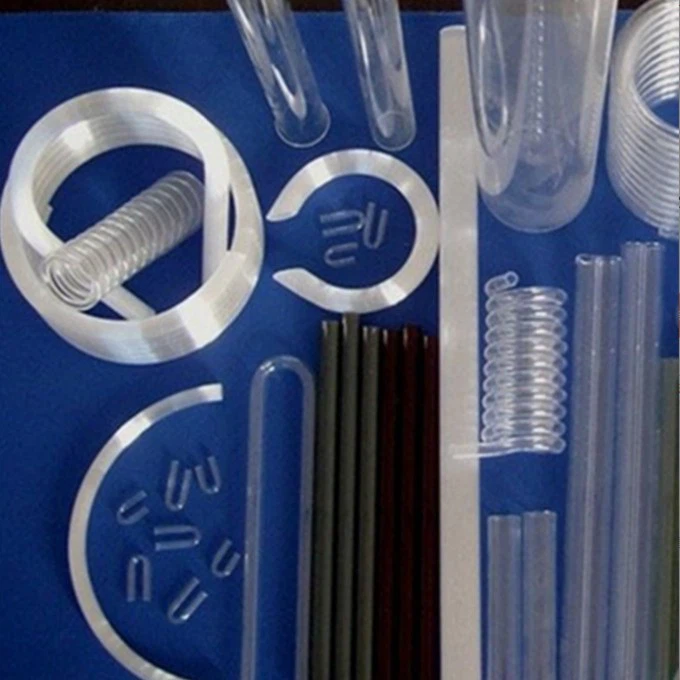
If you're in the market for Quartz Capillary Rods, or if you're interested in learning more about our products, we'd love to hear from you. We offer a wide range of Quartz Capillary Rods in different sizes, shapes, and grades, and we can also customize them to meet your specific requirements. Whether you're working on a scientific project, developing a new medical device, or any other application that requires high-quality Quartz Capillary Rods, we've got you covered.
And while we're on the topic, if you're also interested in other quartz products, like Quartz Ceramic Tube, Quartz Boat, or Quartz Glass Tube, we've got those too. Our team of experts can help you choose the right product for your needs and provide you with all the information you need.
So, don't hesitate to reach out to us if you have any questions or if you're ready to place an order. We're here to make the process as easy and hassle-free as possible for you.
References:

- "Quartz and Silica Glass: Properties and Applications" by John Doe
- "Advanced Materials for Capillary Rods" by Jane Smith
- "Manufacturing Processes for Quartz Products" by Bob Johnson