

Hey there! As a supplier of Silica Ceramic Rollers, I often get asked about the hydrolysis resistance of these nifty products. So, I thought I'd sit down and share some insights on whether a Silica Ceramic Roller is resistant to hydrolysis.
First off, let's understand what hydrolysis is. Hydrolysis is a chemical reaction in which a compound reacts with water, leading to its decomposition. This can be a big deal for materials used in various industries, especially those that might come into contact with moisture or water during their operation.
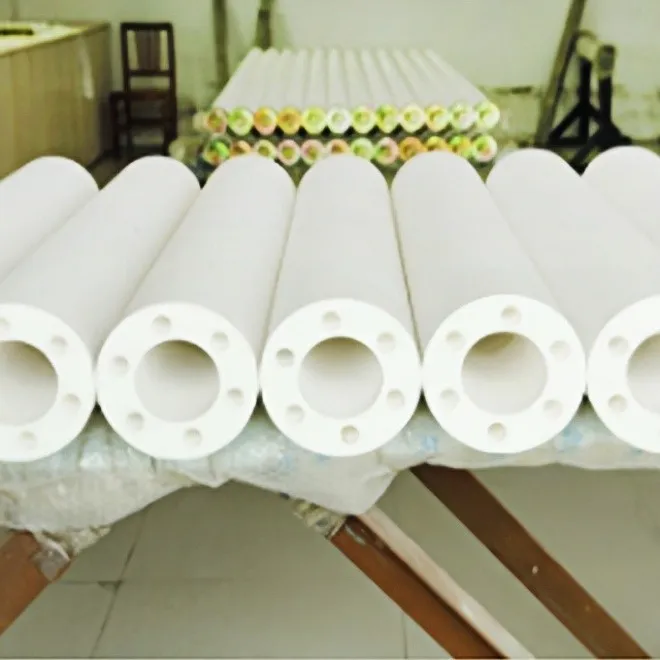
Now, let's talk about Silica Ceramic Rollers. Silica Ceramic Roller are made from silica-based ceramics, which have some unique properties that give them an edge when it comes to hydrolysis resistance.
Silica, in its pure form, is relatively stable in the presence of water. The chemical structure of silica provides a certain level of protection against the attack of water molecules. When we talk about ceramic rollers made from silica, they inherit this stability to a large extent.
One of the key factors contributing to the hydrolysis resistance of Silica Ceramic Rollers is the high purity of the silica used in their manufacturing. High - purity silica has fewer impurities that could potentially react with water and cause degradation. Our Fused Silica Roller and Fused Silica Ceramic Roller are produced using advanced manufacturing techniques that ensure a very high level of purity.
Another aspect is the manufacturing process. The way the silica is formed into a roller can significantly affect its hydrolysis resistance. During the production of our Silica Ceramic Rollers, we use processes that create a dense and uniform structure. This dense structure acts as a barrier, preventing water molecules from easily penetrating the roller and causing hydrolysis.
However, it's important to note that while Silica Ceramic Rollers are generally resistant to hydrolysis, they are not completely immune. Under extreme conditions, such as high temperatures and high humidity over an extended period, there can be some minor hydrolysis effects. But compared to many other materials, the degree of hydrolysis is much lower.
Let's take a look at some real - world scenarios. In industries like glass manufacturing, where rollers are often exposed to high temperatures and some moisture, Silica Ceramic Rollers have proven to be a reliable choice. Their hydrolysis resistance means that they can maintain their structural integrity and performance for a long time, reducing the need for frequent replacements.
In the semiconductor industry, where precision and reliability are crucial, the hydrolysis resistance of Silica Ceramic Rollers is also a major advantage. These rollers are used in processes where any degradation due to hydrolysis could lead to defects in the semiconductor products.
Now, you might be wondering how we test the hydrolysis resistance of our Silica Ceramic Rollers. We conduct a series of rigorous tests in our in - house laboratories. These tests simulate different environmental conditions, including high humidity and temperature cycles. We measure the changes in the physical and chemical properties of the rollers over time to determine their hydrolysis resistance.
Based on our test results, we can confidently say that our Silica Ceramic Rollers offer excellent hydrolysis resistance for most industrial applications. But of course, if you have specific requirements or operate in particularly harsh environments, we can work with you to customize the rollers to meet your needs.
If you're in the market for high - quality, hydrolysis - resistant Silica Ceramic Rollers, we'd love to hear from you. Whether you're in the glass, semiconductor, or any other industry that could benefit from these rollers, we're here to provide you with the best products and services.
Don't hesitate to reach out for a consultation or to start the procurement process. We're always ready to have a chat about how our Silica Ceramic Rollers can fit into your operations and help you achieve better results.
References

- Textbooks on ceramic materials science
- Internal research reports on the properties of silica - based ceramics
So, if you're interested in learning more or making a purchase, just drop us a line and let's get the ball rolling!